
 Martin K
 Why 2026 Must Be Read Through Continuity
Analyses of African politics have long been structured around moments of rupture, such as coups, elections, peace agreements, or humanitarian emergencies, which are frequently interpreted as decisive turning points in the continent’s political trajectory. While such events undoubtedly matter, the cumulative developments of 2025 suggest that episodic readings risk obscuring a more consequential reality. As Africa enters 2026, the dominant pattern is not rupture or systemic breakdown, but continuity under strain: a condition in which political, social, and humanitarian systems persist while operating under increasing pressure.
By the end of 2025, a growing number of African States were governed by military or hybrid political regimes, while multilateral institutions estimated that close to half of the continent’s population lived in fragile or conflict-affected settings. Humanitarian needs reached historic highs, climate-related displacement accelerated across the Sahel, the Horn of Africa, and Southern Africa, and peace operations faced mounting constraints in mandate, resources, and political support. Simultaneously, Africa’s external relations were recalibrated amid a fragmenting global order, as the UN, European Union, the United States, Canada, China, and Russia increasingly framed engagement through the lenses of security, migration management, and strategic competition.
Taken together, these dynamics do not signal imminent collapse. Rather, they point to the consolidation of a political condition in which governance persists without deep legitimacy, peace is managed rather than structurally built, and humanitarian action mitigates suffering without transforming its causes. Youth mobilization continues to shape political discourse, yet with diminishing institutional returns, while climate stress and displacement further strain already fragile social contracts. In this context, stability is increasingly maintained through containment, buffering, and external support rather than through inclusive political settlement or socio-economic transformation.
This essay argues that Africa’s 2026 is best understood as a phase of stability without transformation, a condition shaped by governance under stress, youth political fatigue, geopoliticized humanitarianism, climate-driven displacement, and externally mediated peacebuilding. Rather than forecasting crises or breakthroughs, the analysis advances a continuity-based reading of Africa’s political condition, emphasizing how incremental adjustments, rather than dramatic ruptures, are likely to define the continent’s trajectory in the year ahead.
Governance under Stress, Not Collapse
Despite persistent narratives of State failure, most African States entering 2026 remain administratively intact and politically operative. Governments continue to levy taxes, maintain security forces, regulate economic activity, negotiate international agreements, and exercise territorial authority. The defining feature of the current moment is therefore not institutional breakdown, but structural constraint, a condition in which States govern under sustained fiscal, political, and social pressure.
Fiscal vulnerability has emerged as a central axis of governance stress. In a growing number of African countries, debt servicing now absorbs a larger share of public revenue than combined expenditure on health or education, significantly narrowing fiscal space and policy autonomy. In 2025, the African Development Bank cautioned that rising debt distress increasingly limits State capacity to respond not only to social grievances, but also to climate-related shocks and humanitarian pressures. This compression of resources reinforces a governance logic oriented toward short-term stabilization, maintaining order, servicing obligations, and managing risk, at the expense of long-term developmental investment and social redistribution.
Politically, State legitimacy has become increasingly procedural rather than participatory. Elections continue to be organized and constitutional frameworks formally upheld, yet public trust in political institutions has steadily eroded. In several contexts, constitutions are amended, suspended, or selectively interpreted to accommodate executive consolidation. Military-led governments in Mali, Burkina Faso, and Niger illustrate this shift clearly, having moved from transitional rhetoric toward institutional entrenchment. As Niger’s military leader Abdourahamane Tchiani asserted in 2025, “Stability must come before democracy.” Such statements do not merely reflect individual leadership preferences; they signal a broader recalibration of political priorities in which order and governability are explicitly privileged over pluralism and participation.
Governance in 2026 is therefore best understood not as imminent collapse, but as durable fragility, a condition in which States continue to function and assert authority, yet do so with constrained legitimacy, limited fiscal capacity, and diminishing social consensus. This form of governance is stable enough to endure, but insufficiently transformative to resolve the structural drivers of contestation and vulnerability that persist beneath the surface.
Youth Fatigue and the Limits of Mobilization
Africa’s demographic profile continues to generate expectations of youth-driven political transformation. With a median age of approximately 19 years and more than 60% of the population under 25, young people remain central to protest movements, digital activism, and civic mobilization across the continent. Yet the political dynamics of 2025 revealed a widening disjunction between mobilization and political incorporation, as sustained youth activism failed to translate into durable institutional influence.
Empirical trends underscore this gap. Youth unemployment and underemployment rates remain persistently high, exceeding 30% in several countries, including among university graduates. At the same time, protest cycles increasingly encountered repression, surveillance, or co-optation rather than reform. Data from human rights organizations indicate that 2025 saw a rise in the criminalization of protest and civic dissent across multiple African States, with restrictions on assembly, digital expression, and political organizing becoming more prevalent. These dynamics have produced what scholars describe as mobilization fatigue: a condition in which participation continues, but with diminishing expectations of impact.
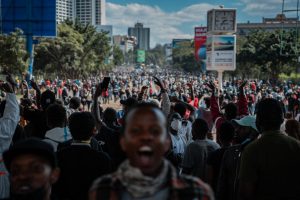
Street Demonstrations are emerging as new civic frontiers for Tanzania’s youth. Photo: Pexels (CC0).
As former Liberian president, Ellen Johnson Sirleaf observed during a 2025 governance forum, “Young people are speaking loudly, but institutions are not listening deeply.” In this context, the central risk for 2026 is not youth radicalization, but youth political withdrawal, a gradual retreat from formal political engagement driven by disillusionment rather than apathy. Such withdrawal, while less visible than protest, carries significant implications for peacebuilding and governance frameworks that assume youth participation without addressing the structural barriers that limit youth agency and inclusion.
Peacebuilding in an Era of Containment
Peacebuilding across Africa has increasingly shifted from transformative ambition toward conflict management and stabilization. United Nations peace operations, African Union–led missions, and donor-funded peacebuilding programs remain active across the continent, yet their mandates and political reach have narrowed. Rather than advancing comprehensive political settlements or reconciliation processes, contemporary peacebuilding efforts increasingly prioritize ceasefire maintenance, civilian protection, and the containment of violence within constrained operational frameworks.
By 2025, Africa hosted the majority of the world’s UN peacekeeping missions, yet several operated under reduced troop levels, restricted freedom of movement, or shortened mandates. UN officials openly acknowledged mounting limitations, citing host-state resistance, persistent funding shortfalls, and deepening geopolitical divisions within the UN Security Council. As UN Secretary-General António Guterres warned in 2025, “peacekeeping cannot substitute for political will.” In multiple conflict-affected contexts, political dialogue remained stalled, transitional processes prolonged, and peace agreements only partially implemented.
Consequently, peacebuilding in 2026 is likely to function within a logic of containment rather than transformation, preserving a minimum level of order and preventing escalation without addressing the structural grievances, governance deficits, and social exclusions that underpin recurring instability. This shift reflects not the absence of peacebuilding activity, but a redefinition of its ambition in an increasingly constrained political and geopolitical environment.
Climate Change, Displacement, and the Refugee Question
Climate change has emerged as a central driver of instability across Africa, interacting with conflict dynamics, weak governance, and socio-economic vulnerability. Rising temperatures, prolonged droughts, flooding, and environmental degradation have increasingly undermined livelihoods, particularly in agrarian and pastoral regions, contributing to large-scale displacement. International monitoring bodies estimate that Africa accounts for a disproportionate share of global climate-related internal displacement, with millions displaced annually due to weather-related disasters alone, often in contexts already affected by conflict or political fragility.

The governance of displacement and refuge, however, has become deeply politicized. Migration and asylum policies are increasingly shaped by security and containment priorities rather than protection imperatives. European Union partnerships with African States continue to emphasize border externalization, return mechanisms, and migration deterrence, while North American actors, including the United States and Canada, frame engagement primarily around stabilization, resilience-building, and climate adaptation. Although Canadian policy statements in 2025 reaffirmed commitments to climate finance and adaptation support, funding levels remain modest relative to the scale of displacement and structural vulnerability.
African political leaders have responded by reframing climate vulnerability as an issue of global responsibility rather than domestic failure. As Kenyan President William Ruto stated at the 2025 United Nations General Assembly, “Africa is not asking for charity, but for fairness in a crisis it did not create.” In 2026, climate-induced displacement is therefore likely to strain further governance capacity, humanitarian systems, and international solidarity, while exposing persistent tensions between responsibility, protection, and geopolitical self-interest in global refugee governance.
Africa and the Fragmenting Global Order
Africa’s international relations in 2026 are increasingly shaped by strategic diversification rather than ideological alignment. African states engage simultaneously with the European Union, the United States, Canada, China, Russia, and multilateral institutions, navigating a global environment marked by geopolitical fragmentation and competing development, security, and governance agendas.
China remains a central economic partner, particularly through infrastructure financing, trade, and industrial investment, though engagement has become more cautious amid growing concerns over debt sustainability and project viability. Russia expanded security cooperation with selected African governments in 2025, framing its engagement in terms of sovereignty, non-interference, and pragmatic partnership. Western actors, meanwhile, have recalibrated their approaches, increasingly balancing normative commitments to democracy and human rights with security priorities, counterterrorism cooperation, and migration management. The European Union’s partnerships with African states continue to reflect this dual logic, combining development assistance with border externalization and stabilization objectives, while Canada’s engagement emphasizes multilateralism, climate action, and institutional capacity-building within constrained geopolitical space.

As former French president Emmanuel Macron acknowledged in 2025, “Africa is no longer a terrain of influence, but a space of competition.” African governments have responded with greater diplomatic agency, selectively leveraging partnerships to advance national interests. Yet this agency remains constrained by structural asymmetries in economic power, security dependence, and global decision-making authority. In 2026, Africa’s position within the fragmenting global order will thus be characterized by increased maneuverability, but limited advantage in terms of engagement.
Managed Instability as Africa’s Emerging Political Condition
Taken together, the dynamics examined in this article point toward the consolidation of an emerging political condition best described as managed instability. Across much of the continent, governance persists under sustained fiscal and legitimacy constraints; youth mobilization continues without meaningful institutional incorporation; peacebuilding efforts prioritize containment over political transformation; humanitarian action mitigates suffering without addressing structural causes; and external actors increasingly privilege predictability and risk management over long-term change.
This condition is neither chaotic nor transitional. Rather, it reflects a political equilibrium in which instability is actively contained, buffered, and regulated rather than resolved. As Achille Mbembe has argued, contemporary African politics increasingly operates within “a horizon of management rather than emancipation,” where the objective is not to transform underlying power relations, but to render them governable. Managed instability is therefore stable enough to endure, yet sufficiently constrained to inhibit deep social, political, and economic transformation.
Understanding Africa’s 2026 through this lens shifts analytical attention away from episodic crises and toward the cumulative effects of governance under stress, depoliticized participation, and geopoliticized intervention. The central challenge is not the absence of order, but the normalization of a political condition in which continuity itself becomes the principal obstacle to transformative change.
What 2026 Will Test
Rather than serving as a year of decisive rupture or dramatic breakthrough, 2026 should be understood as a series of structural tests confronting African States, societies, and their international partners. The first of these concerns political legitimacy. Across much of the continent, governments have demonstrated an ability to maintain administrative control and territorial authority, yet often without broad social inclusion or meaningful participation. The central question for 2026 is therefore whether governability can be sustained in the absence of expanded legitimacy, or whether prolonged exclusion will continue to erode trust in state institutions over time.
A second test lies in the domain of peacebuilding. While violence has been contained in several conflict-affected contexts through ceasefires, stabilization missions, and security partnerships, political settlements and reconciliation processes remain fragile or stalled. In 2026, the durability of peace will depend less on the maintenance of order than on the willingness and capacity of political actors to move beyond containment toward inclusive political dialogue. The risk is that prolonged stabilization without settlement may institutionalize conflict dynamics rather than resolve them.
Climate governance and displacement constitute a third test. As climate-related shocks intensify, States and international actors face growing pressure to respond to displacement without defaulting to securitized approaches that frame mobility as a threat rather than a governance challenge. Whether climate-induced displacement can be managed through adaptation, protection, and long-term planning, rather than containment and deterrence, will significantly shape social stability and regional cooperation in the years ahead.
Finally, 2026 will test the nature of international partnerships with Africa. External actors continue to play a central role in shaping governance, peacebuilding, humanitarian response, and climate adaptation, yet their engagement is often mediated through strategic, security, or migration-related interests. The key question is whether international partners can support transformative processes without instrumentalizing African institutions and populations in the service of external agendas.
The answers to these tests are unlikely to emerge through dramatic turning points. Instead, they will unfold incrementally, through shifts in policy practice, political inclusion, and institutional trust, quietly shaping Africa’s trajectory beyond 2026.
Conclusion: The Cost of Stability without Transformation
Africa’s 2026 is unlikely to be defined by dramatic rupture or systemic breakdown. Its more consequential risk lies in the normalization of stability without justice, governance maintained without broad legitimacy, and peace sustained without reconciliation. Across political, social, and humanitarian domains, continuity has become the dominant organizing principle, managing risk, containing disorder, and preserving order without addressing the structural conditions that generate fragility.
This form of stability, while often presented as pragmatic, carries high long-term costs. Prolonged governance under constraint deepens exclusion, repeated mobilization without incorporation exhausts civic engagement, and peacebuilding without political settlement postpones reconciliation rather than securing it. As Léopold Sédar Senghor once observed, “Peace is not merely the absence of conflict, but the presence of dignity.” Without dignity, expressed through inclusion, justice, and meaningful participation, continuity itself becomes corrosive.
Stability without transformation may endure in the short term, but it does so at the expense of deferred justice, fatigued societies, and increasingly constrained political futures. Reading Africa’s 2026 through continuity rather than crisis thus reveals not the absence of change, but the urgent need to reconsider the limits of order as a substitute for transformation.
Afterword
This analysis is offered as a situated reading of Africa’s political condition at a specific historical moment. As with all structural interpretations, it is necessarily partial and subject to revision as political dynamics evolve. Future developments, whether incremental reforms or unexpected ruptures, may alter the contours of stability and stagnation outlined here. Nevertheless, the value of continuity-based analysis lies not in forecasting events, but in illuminating the structural constraints within which such events unfold.
 About the Author
Martin is an independent researcher in Peace and Conflict Studies and International Relations, with a focus on governance, youth political participation, peacebuilding, and climate & migration in Africa. His work examines the intersections between political legitimacy, humanitarian governance, and global power dynamics, with a particular focus on youth agency and structural transformation. He is the founder of kumartinez.com, an independent academic-policy platform where he publishes analytical essays and policy reflections, and engages in research and advisory work.